Building AI-Powered Backend Services: Why Most Integrations Break in Production

The integration looked solid. In testing, the AI-powered document extraction service worked exactly as designed — pull a PDF, send it to the model, parse the structured output, write to the database. Latency was acceptable. Outputs were clean. We shipped it.
Three days after going live, client reports started coming in. Extracted data was missing fields. Some records had partial output. A handful had nothing at all. The service wasn't throwing errors. Logs showed successful API calls. The model was returning responses — they just weren't what we expected.
The root cause: in testing, we'd used short, simple documents. In production, clients uploaded complex multi-page PDFs. The model's output structure drifted — fields appeared in different orders, optional sections were omitted, the JSON we were parsing sometimes contained prose where we expected a value. We'd built the parsing layer assuming the model always returned a consistent structure. It didn't.
No error. No alert. Silent data loss.
Why AI Integrations Are Different
A REST API call either succeeds or fails in a way you can detect. Status codes, error bodies, timeouts — the failure modes are well-defined. You write a retry, you write an error handler, and you know what you're dealing with.
LLM API calls fail differently. The HTTP request can return 200 with a well-formed response body that contains output you can't use. The model might:
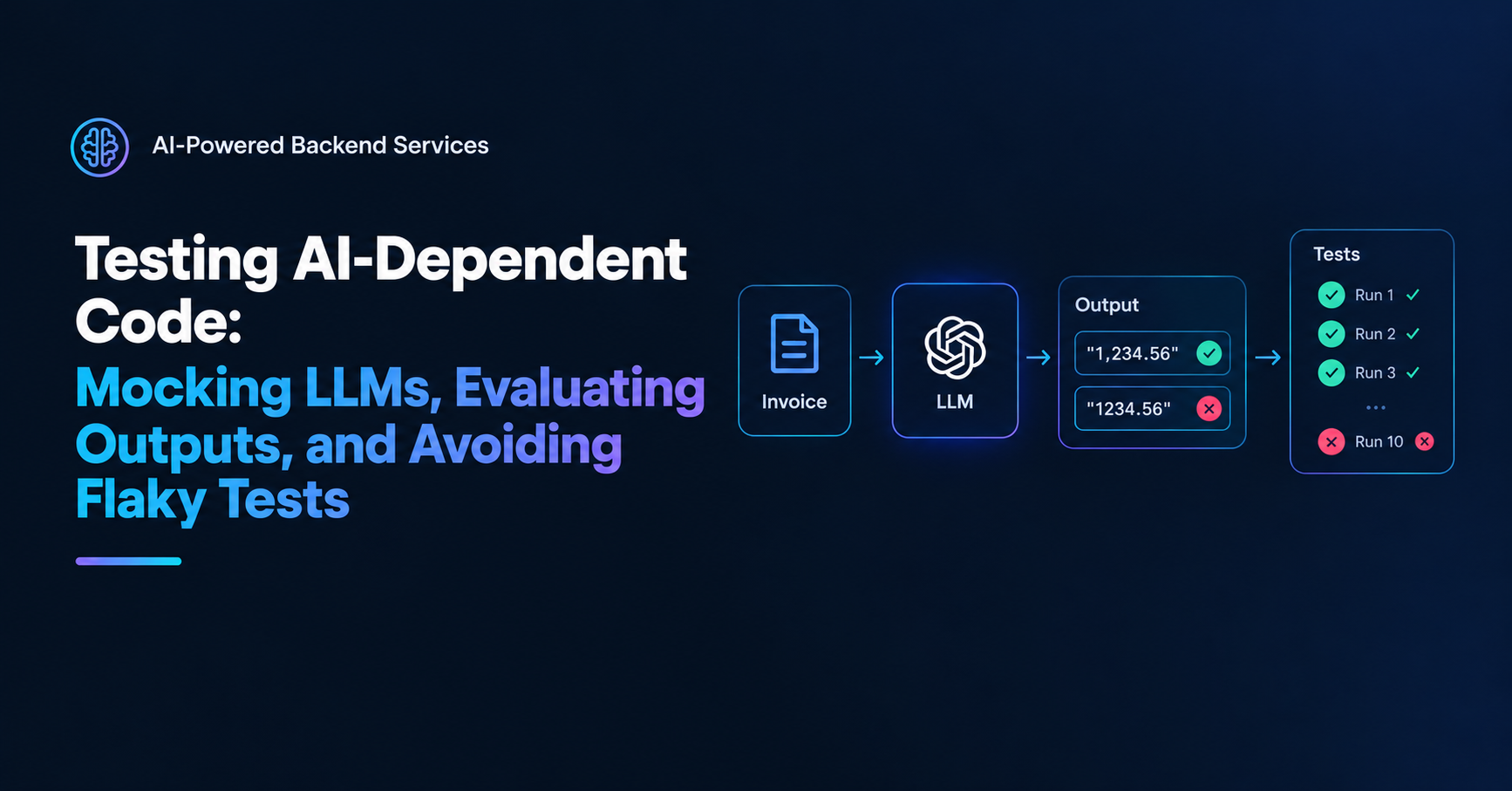
Return valid JSON that doesn't match your expected schema
Truncate output mid-sentence when it hits a token limit
Interpret an ambiguous prompt differently than it did in testing
Produce structurally correct output with factually wrong values
Respond slowly enough to exceed your downstream timeout, but fast enough that you don't configure a sensible one
None of these show up as errors in your API client. They show up as data quality issues, silent failures, or confused end users — often days after the fact.
The Five Reasons Most Integrations Break
1. No output validation
The most common failure. You call the model, get a response, and pass it downstream without checking whether it matches what you need. In testing, the model is consistent enough that this works. In production, edge cases in real data expose inconsistencies you didn't anticipate.
The fix isn't clever prompt engineering — it's treating model output like untrusted external input and validating it the same way you'd validate an API response from a third party. Pydantic, schema validation, explicit checks before any downstream write.
2. Prompts treated as static strings
A prompt that works today may not work after a model update, a context window change, or a shift in the input data. Teams that hardcode prompts as string literals in their service code have no way to iterate, version, or roll back a prompt change without a code deployment.
Prompts are configuration, not code. They belong in a versioned store, not string constants.
3. No fallback when the model fails
LLM APIs have rate limits, occasional downtime, and elevated latency during high-demand periods. Services that make synchronous blocking calls to an LLM API in the request path are one OpenAI outage away from a full service degradation.
Every AI integration needs a defined behaviour for when the model is unavailable: queue the work and process it later, return a graceful degraded response, or fail fast with a meaningful error rather than hanging.
4. Token limits treated as someone else's problem
Context windows have limits. Large inputs get truncated, sometimes silently, sometimes with a clear error, depending on how you're calling the API. Teams that don't explicitly manage token counts end up with truncated outputs that look complete until someone looks closely.
This is especially common with document processing — a service built on short test documents works fine until a client uploads a 40-page PDF.
5. Cost left unmonitored until the bill arrives
LLM API costs scale with usage in ways that aren't always intuitive. A feature that costs pennies in testing can cost hundreds of dollars in production if usage is higher than expected, if prompts are larger than necessary, or if a retry loop is accidentally calling the API in a tight loop.
Without per-endpoint cost tracking and usage alerts, the first signal is a monthly bill that's ten times what you expected.
The document extraction service wasn't badly built. It just treated the LLM as a reliable structured data source rather than a probabilistic system that needs the same defensive patterns you'd apply to any external dependency.
About the author
- Senior full-stack engineer and engineering lead with 5+ years building cloud-native systems at scale. I write about the things the docs don't cover — GCP, FastAPI, Terraform, event-driven architecture, and AI-powered backends. No hello-world demos.
Comments
Join the discussionNo comments yet. Be the first to comment.
AI-Powered Backend Services
LLM APIs don't fail the way REST APIs do. A 200 response with a well-formed body can still contain output you can't use, costs you didn't expect, or behaviour that changed silently after a model update. This series covers building AI-powered backend services that hold up in production — prompt management, output validation, async pipelines, cost control, testing non-deterministic code, and deployment patterns for variable-latency workloads. Written from real experience integrating OpenAI and Gemini into production FastAPI services on GCP.